
NM SKILLS: Everyone You Need Is Already Here
NM SKILLS: Everyone You Need Is Already Here
NM SKILLS: Everyone You Need Is Already Here
03/03
03/03
Nørgaard & Mikkelsen, 2026
Nørgaard & Mikkelsen, 2026
my role in this project was research and design.
the tools we used were Figma, Adobe Illustrator,
Maze for testing, and Visual Studio Code
for the development.
Nørgaard & Mikkelsen, 2026
my role in this project was research and design.
the tools we used were Figma, Adobe Illustrator,
Maze for testing, and Visual Studio Code
for the development.
my role in this project was research and design.
the tools we used were Figma, Adobe Illustrator,
Maze for testing, and Visual Studio Code
for the development.
// BACKGROUND
Nørgård Mikkelsen is an ad agency spread across five departments and two cities. The work is deeply cross-disciplinary, but knowing who could actually do what wasn't - so the right people got found by asking around, or missed entirely.
We heard the same thing again and again in interviews and surveys across the agency: people sensed there were skills in their colleagues they didn't know about, worked across departments more than the org chart suggested, and often felt out of the loop on what was happening elsewhere in the building. The knowledge existed. The map didn't.
// BACKGROUND
Nørgård Mikkelsen is an ad agency spread across five departments and two cities. The work is deeply cross-disciplinary, but knowing who could actually do what wasn’t - so the right people got found by asking around, or missed entirely.
We heard the same thing again and again in interviews and surveys across the agency: people sensed there were skills in their colleagues they didn’t know about, worked across departments more than the org chart suggested, and often felt out of the loop on what was happening elsewhere in the building. The knowledge existed. The map didn’t.
// BACKGROUND
Nørgård Mikkelsen is an ad agency spread across five departments and two cities. The work is deeply cross-disciplinary, but knowing who could actually do what wasn’t - so the right people got found by asking around, or missed entirely.
We heard the same thing again and again in interviews and surveys across the agency: people sensed there were skills in their colleagues they didn’t know about, worked across departments more than the org chart suggested, and often felt out of the loop on what was happening elsewhere in the building. The knowledge existed. The map didn’t.
Short & Sweet: Design process overview
The challenge was a lack of visibility across the agency - while skills existed across teams, there was no clear way to find the right people, leading to inefficiency and missed opportunities. Research showed that employees relied on informal knowledge and word-of-mouth, and that job titles failed to reflect actual capabilities. As a result, relevant expertise often remained hidden.
We designed NM Skills as a search-driven internal tool where users describe their need in natural language and receive ranked matches based on real project experience. Each match is explained, making the system transparent and trustworthy.
To reduce friction, onboarding auto-generates profiles from existing data (CV/LinkedIn), ensuring fast adoption while capturing both professional skills and personal interests. The experience extends from finding individuals to assembling teams, with AI-assisted project setup and team suggestions.
The result is a shift from manual searching to structured discovery - reducing a multi-day process to minutes, and making hidden expertise visible across the organization.
Short & Sweet: Design process overview
The challenge was a lack of visibility across the agency - while skills existed across teams, there was no clear way to find the right people, leading to inefficiency and missed opportunities. Research showed that employees relied on informal knowledge and word-of-mouth, and that job titles failed to reflect actual capabilities. As a result, relevant expertise often remained hidden.
We designed NM Skills as a search-driven internal tool where users describe their need in natural language and receive ranked matches based on real project experience. Each match is explained, making the system transparent and trustworthy.
To reduce friction, onboarding auto-generates profiles from existing data (CV/LinkedIn), ensuring fast adoption while capturing both professional skills and personal interests. The experience extends from finding individuals to assembling teams, with AI-assisted project setup and team suggestions.
The result is a shift from manual searching to structured discovery - reducing a multi-day process to minutes, and making hidden expertise visible across the organization.
Short & Sweet: The design process from A-Z
We started by identifying a gap between Basic & More’s in-store experience and their online presence. While the physical stores thrive on discovery and constantly changing stock, the webshop felt static and failed to communicate the brand’s core appeal.
Through research and user testing, we uncovered two key issues: users didn’t understand the business model behind the low prices, and browsing felt effortful rather than exploratory.
From this, we defined a concept built around the store’s natural rhythm - a weekly drop called Ugens Fund. The idea was to translate the feeling of “what’s new this week?” into a digital habit, using curated scenes, subtle urgency, and interactive elements to encourage exploration.
We then designed an experience that replaces traditional product grids with styled environments and clickable hotspots, keeping users in context while surfacing product information. At the same time, we clarified the business model through simple visual storytelling and reduced friction in browsing with a more visual, scan-friendly navigation.
The solution was validated through user testing, where the interactive imagery and weekly concept stood out as key strengths - insights that shaped later refinements to accessibility, visual balance, and content hierarchy.
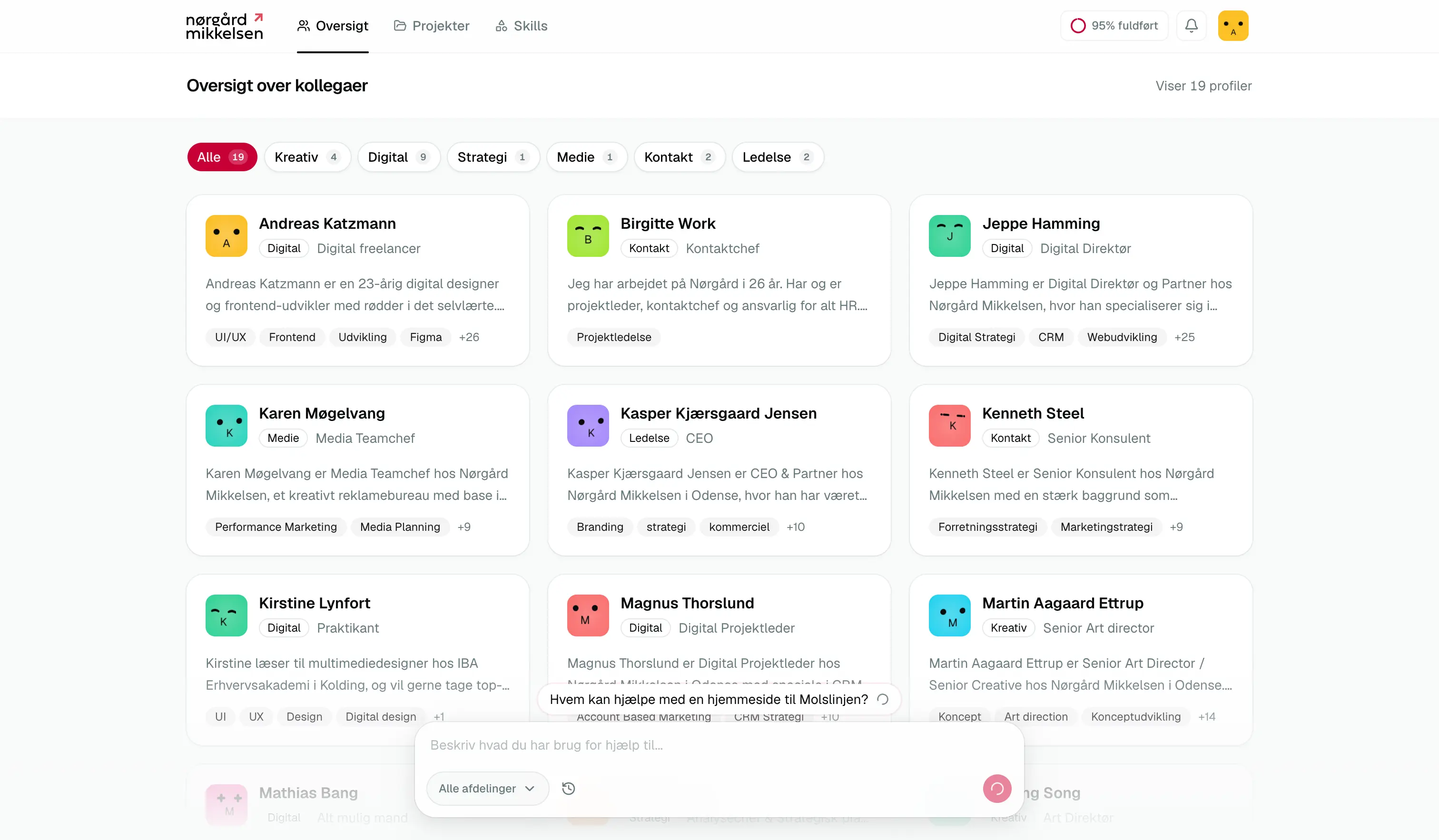
ONBOARDING
The whole product had to prove, in its first few minutes, that it wasn't "another system to maintain." So it opens with a short walkthrough that shows how the pieces connect before anyone's asked to do anything.
Profiles are never started from a blank page - people point the tool at a CV or LinkedIn and it drafts the profile for them, with a human confirming everything before it saves. The last steps deliberately ask about interests and passions, not just job titles - two people can have the same CV, but the one who's genuinely into a subject is the better match.
ONBOARDING
The whole product had to prove, in its first few minutes, that it wasn’t “another system to maintain.” So it opens with a short walkthrough that shows how the pieces connect before anyone’s asked to do anything.
Profiles are never started from a blank page - people point the tool at a CV or LinkedIn and it drafts the profile for them, with a human confirming everything before it saves. The last steps deliberately ask about interests and passions, not just job titles - two people can have the same CV, but the one who’s genuinely into a subject is the better match.
ONBOARDING
The whole product had to prove, in its first few minutes, that it wasn’t “another system to maintain.” So it opens with a short walkthrough that shows how the pieces connect before anyone’s asked to do anything.
Profiles are never started from a blank page - people point the tool at a CV or LinkedIn and it drafts the profile for them, with a human confirming everything before it saves. The last steps deliberately ask about interests and passions, not just job titles - two people can have the same CV, but the one who’s genuinely into a subject is the better match.

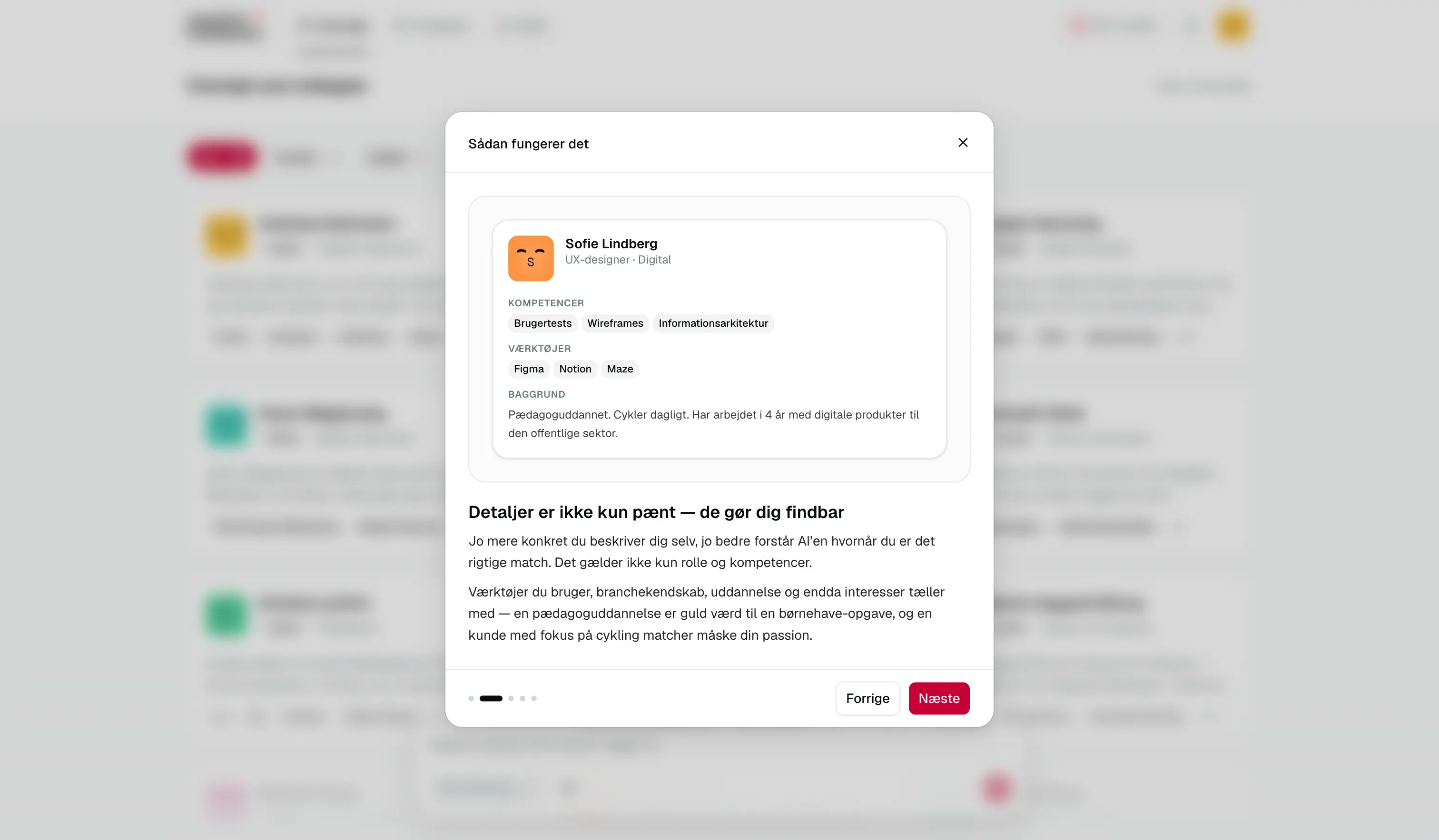
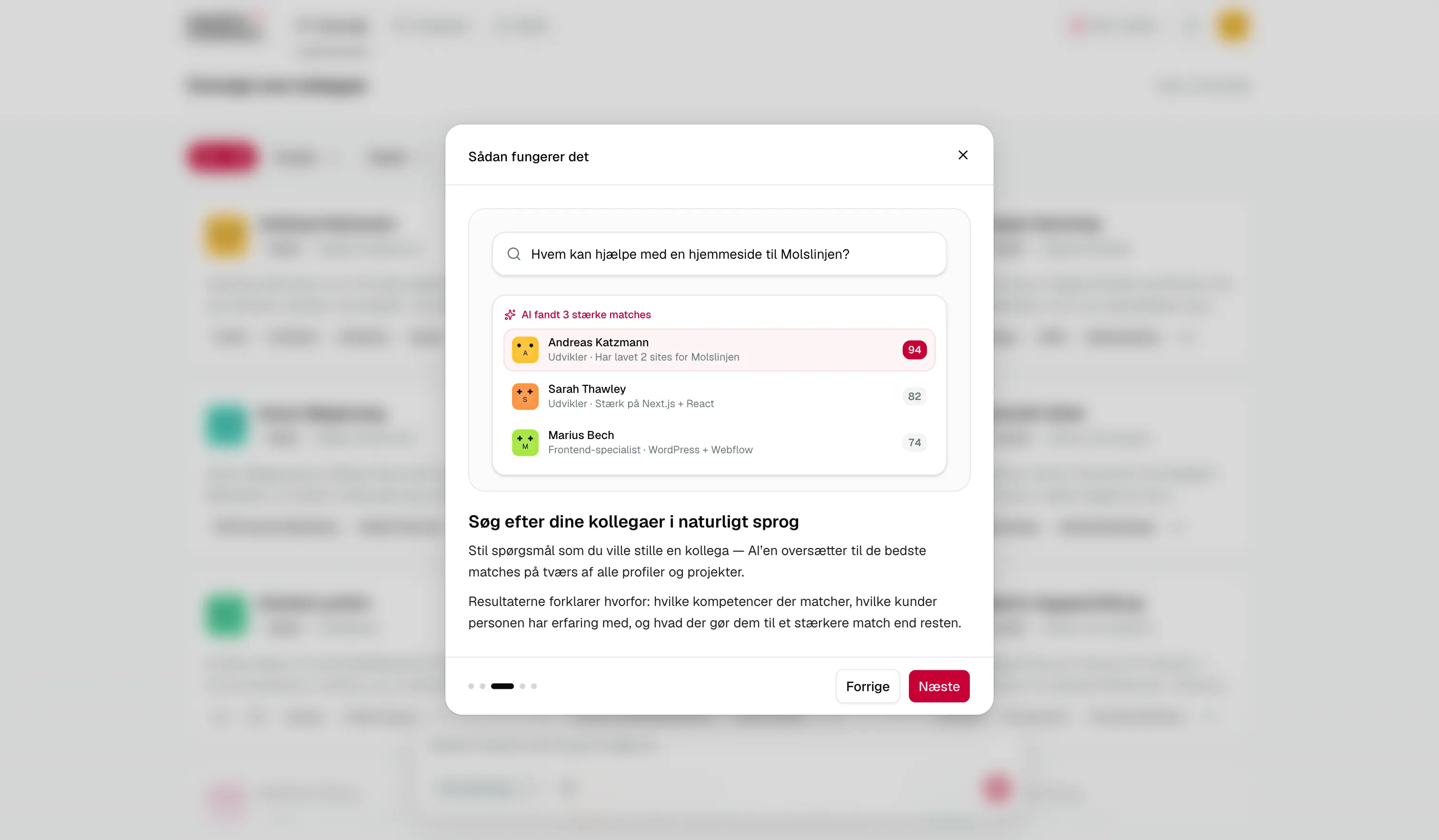

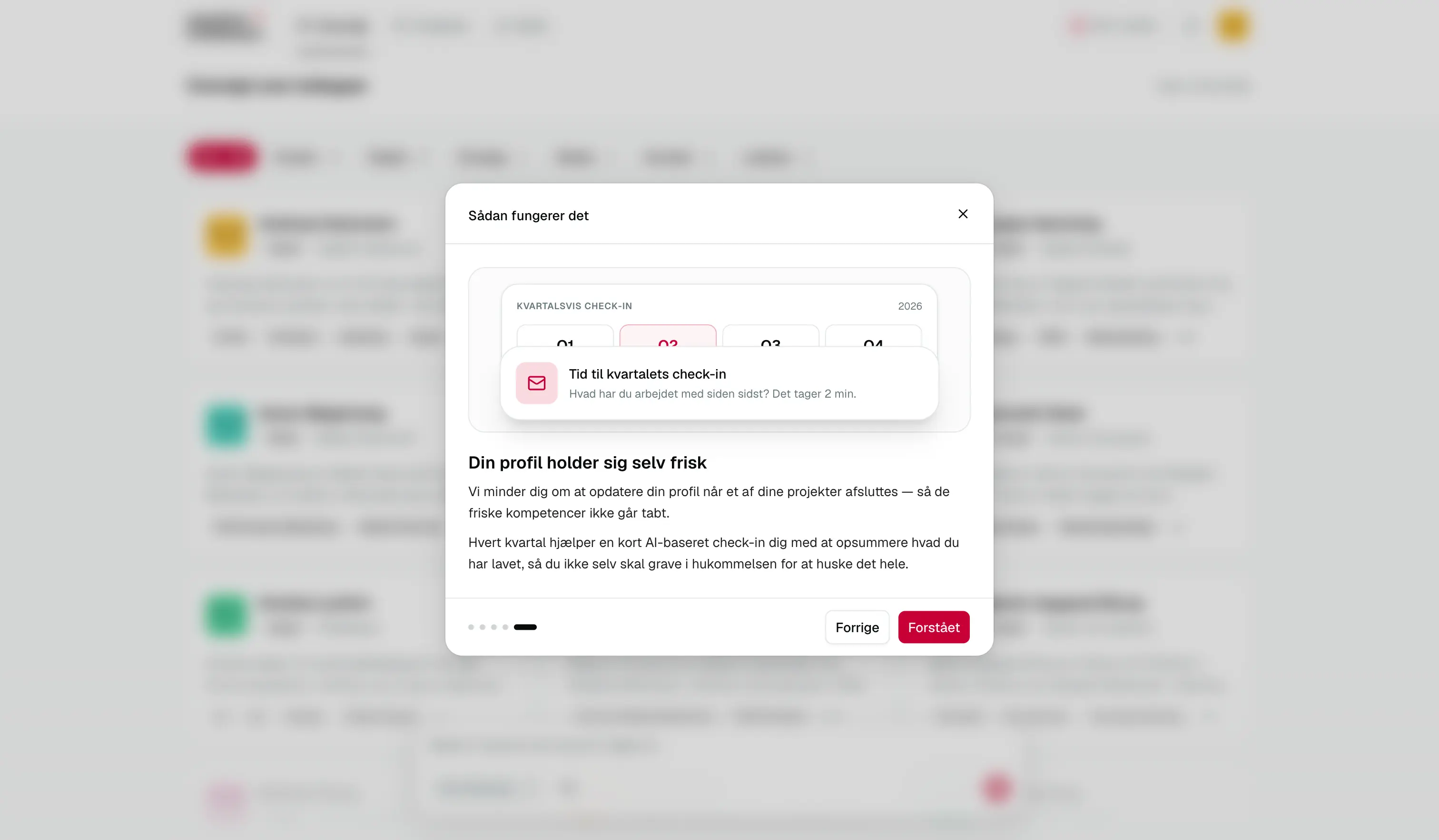
A short onboarding introduces how profiles, projects and AI-powered search work together, while showing users how their information stays useful and up to date.
A short onboarding introduces how profiles, projects and AI-powered search work together, while showing users how their information stays useful and up to date.
A short onboarding introduces how profiles, projects and AI-powered search work together, while showing users how their information stays useful and up to date.
Search by need, not by job title
Instead of a keyword directory, people describe what they need in their own words and get back ranked colleagues with a plain-language reason for each match - including people whose best skills aren't in their job title.
Every match is scored and explained, grounded in real project history rather than a guess - so the answer is auditable, not a black box. Clicking a skill directly flips the question around: instead of "who fits this brief?", it answers "who here can do this?"
Search by need, not by job title
Instead of a keyword directory, people describe what they need in their own words and get back ranked colleagues with a plain-language reason for each match - including people whose best skills aren’t in their job title.
Every match is scored and explained, grounded in real project history rather than a guess - so the answer is auditable, not a black box. Clicking a skill directly flips the question around: instead of “who fits this brief?”, it answers “who here can do this?”
Search by need, not by job title
Instead of a keyword directory, people describe what they need in their own words and get back ranked colleagues with a plain-language reason for each match - including people whose best skills aren’t in their job title.
Every match is scored and explained, grounded in real project history rather than a guess - so the answer is auditable, not a black box. Clicking a skill directly flips the question around: instead of “who fits this brief?”, it answers “who here can do this?”
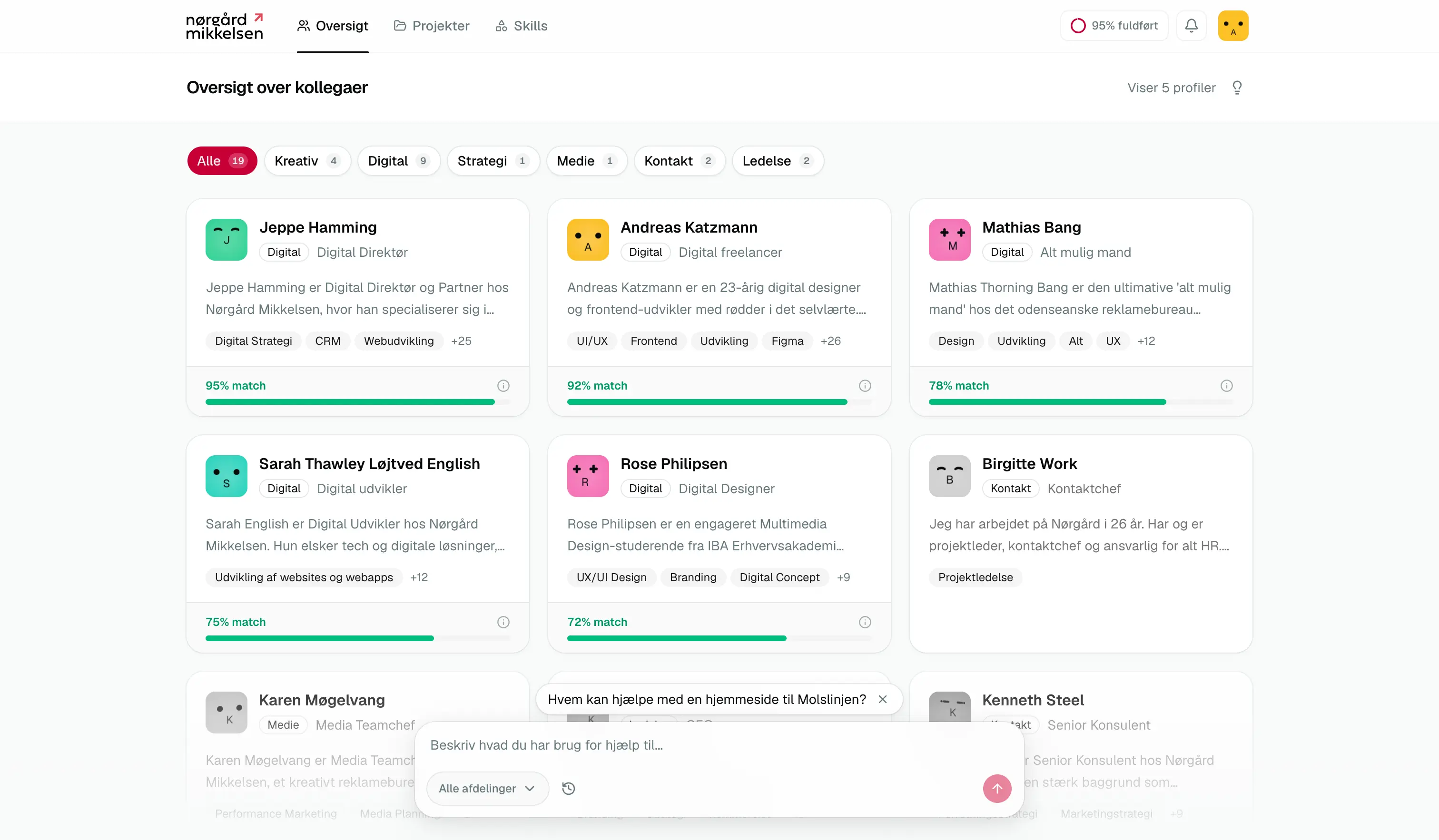
Results for a real brief, ranked by how well each person fits, with a match score attached.
Results for a real brief, ranked by how well each person fits, with a match score attached.
Results for a real brief, ranked by how well each person fits, with a match score attached.

The reverse view - pick a skill, like Webflow, and see everyone in the agency who has it.
The reverse view - pick a skill, like Webflow, and see everyone in the agency who has it.
The reverse view - pick a skill, like Webflow, and see everyone in the agency who has it.
From one match to the right team
Search answers "who's right for this?" - but a brief usually needs a team, not one person. So the directory extends into lightweight project creation, designed to feel like confirming rather than typing.
Dropping in a brief while the form fills itself out underneath - title, client, and the competencies the project will need, ready to confirm rather than type from scratch.
Drop in a brief and the form fills itself in - title, client, the competencies it'll need. From there, a Team Builder proposes a balanced group by reasoning over the brief against everyone's profile, with a short note on why each person fits.
From one match to the right team
Search answers “who’s right for this?” - but a brief usually needs a team, not one person. So the directory extends into lightweight project creation, designed to feel like confirming rather than typing.
Dropping in a brief while the form fills itself out underneath - title, client, and the competencies the project will need, ready to confirm rather than type from scratch.
Drop in a brief and the form fills itself in - title, client, the competencies it’ll need. From there, a Team Builder proposes a balanced group by reasoning over the brief against everyone’s profile, with a short note on why each person fits.
From one match to the right team
Search answers “who’s right for this?” - but a brief usually needs a team, not one person. So the directory extends into lightweight project creation, designed to feel like confirming rather than typing.
Dropping in a brief while the form fills itself out underneath - title, client, and the competencies the project will need, ready to confirm rather than type from scratch.
Drop in a brief and the form fills itself in - title, client, the competencies it’ll need. From there, a Team Builder proposes a balanced group by reasoning over the brief against everyone’s profile, with a short note on why each person fits.

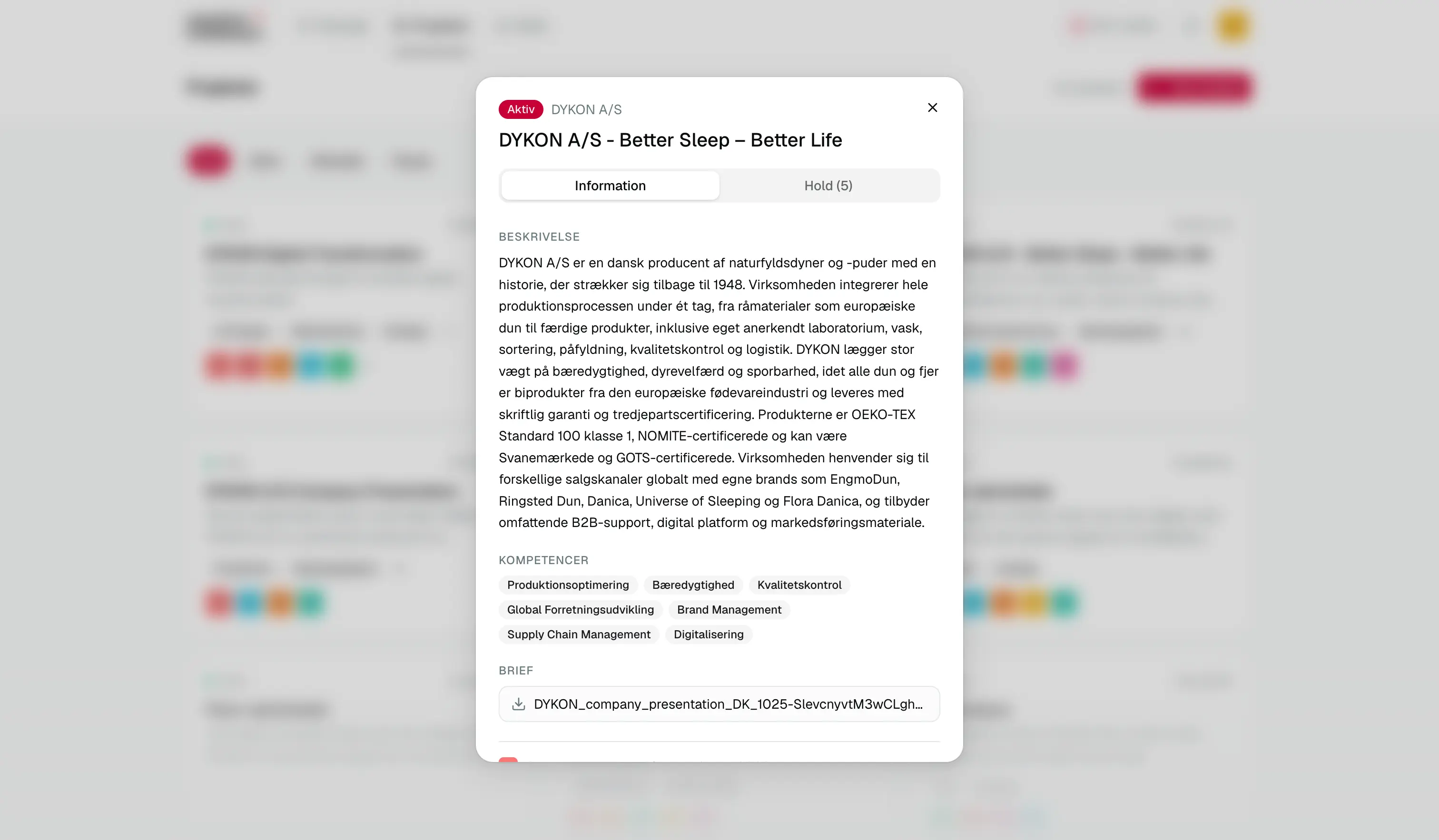
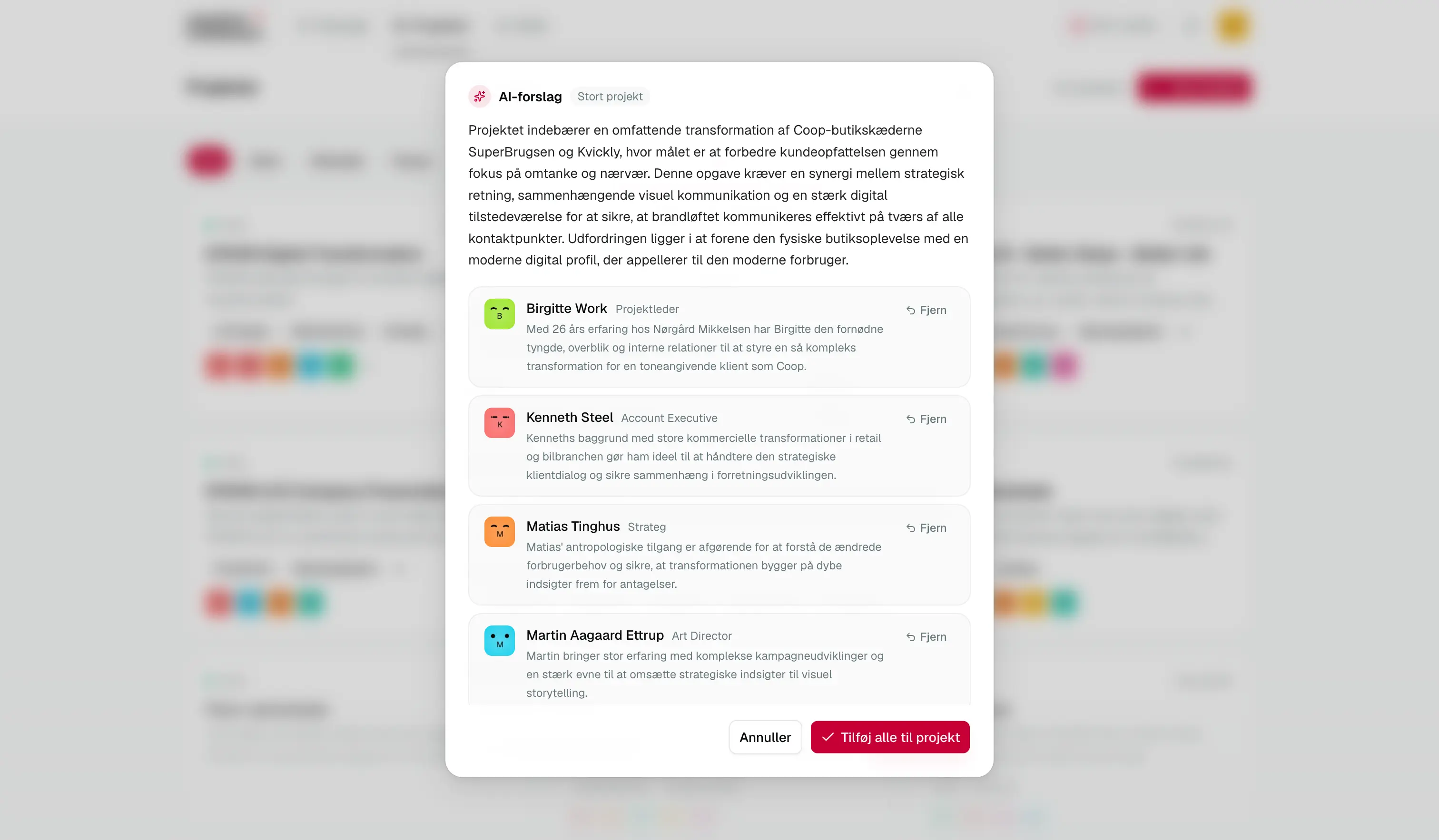
A simple project flow lets users upload a brief, have key details filled in automatically, review the project information and team, and use AI to suggest
the most relevant colleagues before publishing.
A simple project flow lets users upload a brief, have key details filled in automatically, review the project information and team, and use AI to suggest the most relevant colleagues before publishing.
A simple project flow lets users upload a brief, have key details filled in automatically, review the project information and team, and use AI to suggest the most relevant colleagues before publishing.
OUTCOME
NM Skills turns a two-day scavenger hunt into a ten-minute search, and gives quiet specialists a way to be found for the work they're actually best at.
OUTCOME
NM Skills turns a two-day scavenger hunt into a ten-minute search, and gives quiet specialists a way to be found for the work they’re actually best at.
OUTCOME
NM Skills turns a two-day scavenger hunt into a ten-minute search, and gives quiet specialists a way to be found for the work they’re actually best at.